A shipping app for Shopify does one of two jobs. It sets the price the customer sees at checkout, or it helps you buy labels and get parcels out of the door. Shopify already does a good share of both on every plan. Most of the lists that rank for this search come from the companies selling the apps, and they rarely say where the built-in tools are enough.
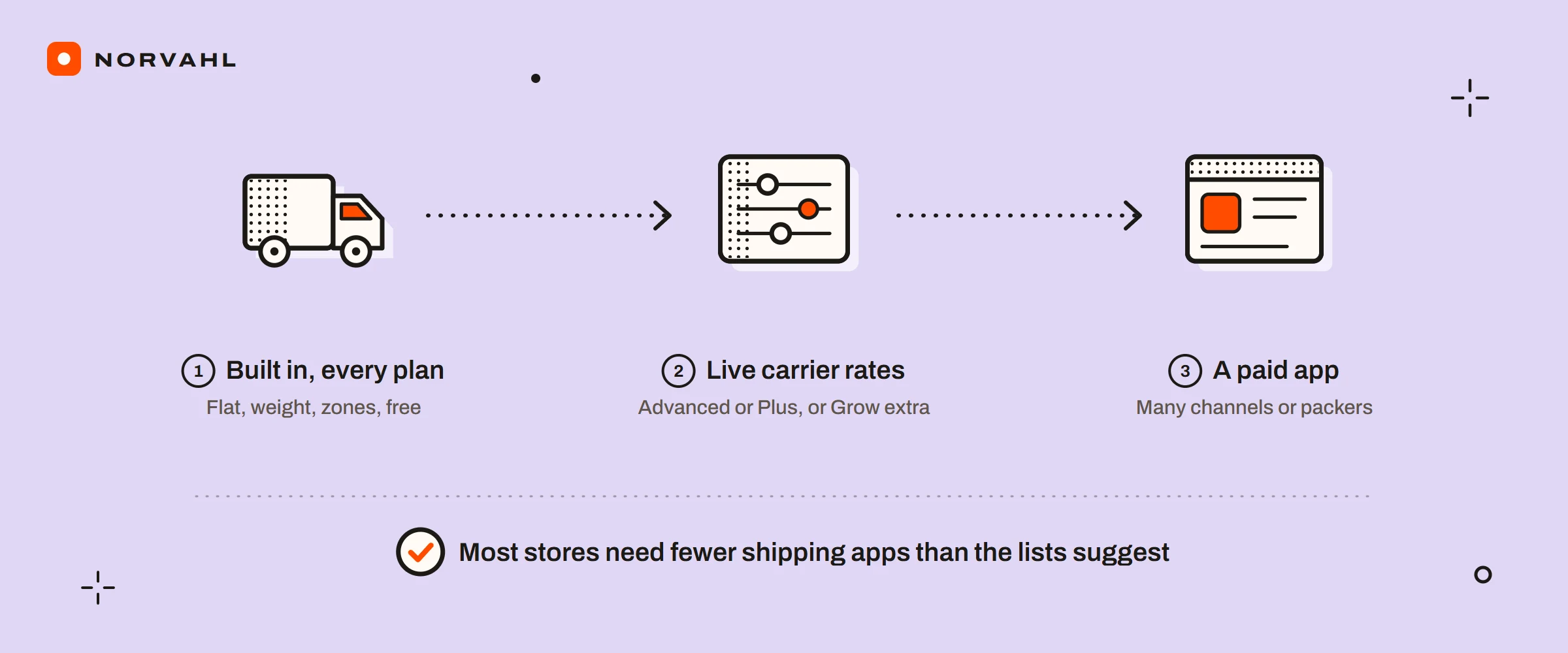
One setting decides more than any list: carrier-calculated shipping. Live rates from your own carrier account, or from an app, need Shopify's Advanced or Plus plan, or Grow with an extra fee. Work out whether you need that before you compare apps, because the apps that show live prices at checkout depend on it.
The short version
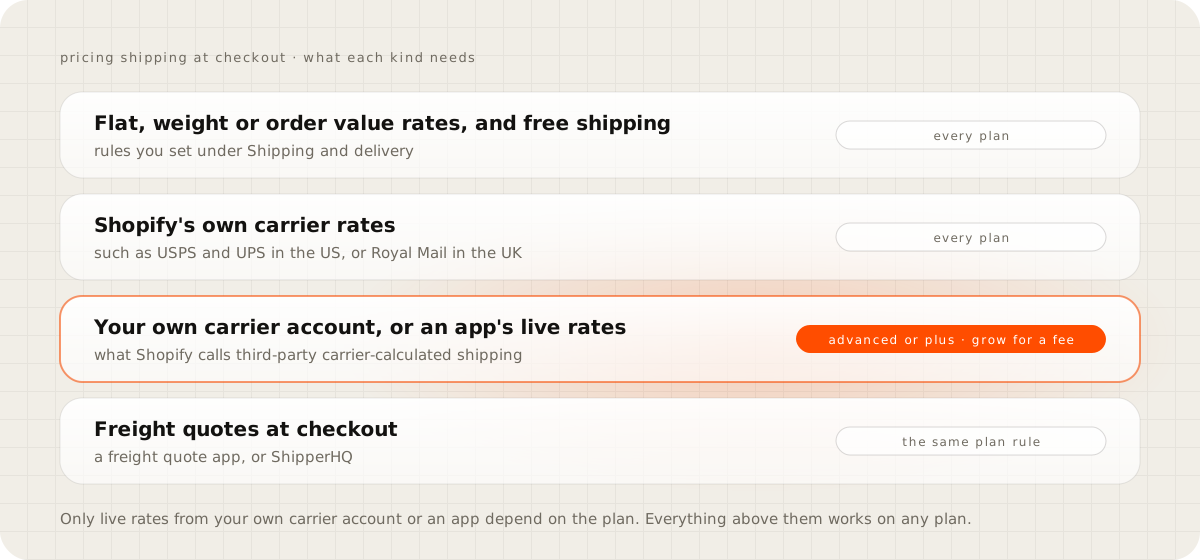
- Flat rates, rates by weight or order value, zones and free shipping are built in on every plan. No app needed.
- Shopify's own carrier rates at checkout also work on every plan, in the countries it supports.
- Live rates from your own carrier account or from an app need Advanced or Plus, or Grow with an extra fee or yearly billing.
- Shopify sells labels in nine countries. Pay for ShipStation, Sendcloud or Starshipit when orders come from several channels, several people pack, or your carriers are not in Shopify.
- Shipping protection is either insurance on your labels or cover the customer opts into at checkout.
Does Shopify handle shipping?#
Not the packing and posting. Shopify sold its logistics business to Flexport in 2023, so orders leave from your own shelves or from a fulfilment company you hire. What Shopify does is the software around shipping: the rates customers see at checkout, labels you can buy in the admin, and tracking.
Labels are the part most owners mean. Shopify's label requirements page lists these carriers:
| Store in | Label carriers in the Shopify admin |
|---|---|
| United States | USPS, UPS, FedEx, DHL Express, DHL eCommerce |
| Canada | Canada Post, DHL Express Canada, and UPS and Purolator for domestic parcels |
| Australia | Australia Post |
| United Kingdom | Royal Mail, Evri, DPD, Yodel, DHL Express Europe |
| France | Colissimo, Chronopost, Mondial Relay, DHL Express Europe |
| Germany | DHL Paket, DHL Express Europe |
| Italy | Poste Italiane, BRT Bartolini, DHL Express Europe |
| Spain | Correos, SEUR, DHL Express Europe |
| Netherlands | DHL eCommerce Netherlands, domestic only, for eligible stores |
The page names no plan requirement for buying labels. It does ask for accurate product weights, package sizes and addresses, and a UK store's address has to be in the UK. Since 28 August 2025, Canada Post parcels from Canada to the US must go as DDP, with duties paid. If your country or your carrier is not in that table, that alone is a reason to look at an app.
When Shopify's built-in rates are enough#
Most shipping setups start with rules you set yourself, and those need no app on any plan. Under Settings, then Shipping and delivery, Shopify's zones and rates page covers:
- A flat rate, one price for an order or for each option, such as Standard and Express.
- Rates by order value, such as a lower price for small orders.
- Rates by weight, which suit stores whose products vary a lot in size.
- Free shipping, added to any rate with a minimum order.
Each zone, such as your own country or Europe, gets its own set of those rates. If you sell heavy and light products, custom shipping profiles let a group of products carry different rates. Shopify is gradually moving profiles and rates to shipping options by market, so the screens in your admin may already look different from older guides. The guide on changing shipping prices on Shopify walks through those settings.
Shopify's own carrier rates are the next step up, and they also work on every plan. The same page lists built-in integrations such as USPS, UPS and DHL in the US, and Canada Post and Purolator in Canada. In Europe it names Royal Mail, DPD and Yodel in the UK, DHL Paket in Germany, BRT in Italy and SEUR in Spain. They quote a live price from the carrier for the customer's order, and like labels, they depend on your product weights being right.
If that covers how you charge, you do not need a rate app. Owners still go looking for one: in one Shopify Community thread, a drop shipper whose rates were all flat was asking for an app to calculate them.
Live carrier rates and the plan that decides them#
Live rates from your own carrier account come under what Shopify calls third-party carrier-calculated shipping, and so do apps that show their own live rates at checkout. Shopify's page on it says it is included on Advanced and Plus. Grow stores can add it for an extra monthly fee or by switching to yearly billing. The page does not give the fee, and it does not list Basic.
Two details on that page explain a lot of confused forum posts. Backup rates you set show only when the live rates fail and no other rate applies. Flat rates show whenever they are eligible, so a customer may pick your flat rate even while the live rates are working. In one Shopify Community thread, an owner had UPS rates switched on and saw only a custom rate at checkout. Check the plan, then check that a zone covers the customer's address, before you blame the carrier.
Best Shopify shipping app for your setup#
The apps below are grouped by the job they do. Their ratings and prices are from each app's Shopify App Store listing, or ShipStation's own pricing page, on 15 September 2026, in US dollars as listed. They change often, and they add to the running costs covered in what an online store costs each month.
You sell on several channels, or several people pack. ShipStation, rated 4.2 from 703 reviews, pulls orders from Shopify, Amazon, Walmart and TikTok Shop into one place, with automation rules and rate shopping across carriers. Its plans are 14.99, 29.99 and 349.99 dollars a month, each starting at 50 shipments, with a 30-day trial and no free plan.
You want more carriers without a monthly fee. Shippo, rated 4.2 from 318 reviews, is free for up to 30 labels a month. Its 19 dollar plan takes you to 10,000 labels and lets you connect your own carrier accounts. Compare its label prices with Shopify's before you switch, since Shopify's are already in your admin.
You ship abroad and want duties shown at checkout. Easyship, rated 4.1 from 394 reviews, is free for 50 shipments a month. Its 29 dollar plan adds live rates at checkout for 500 shipments, and its 69 dollar plan adds import taxes and duties at checkout for 2,500. Showing its rates at checkout still depends on the plan rule above.
Your store is in the UK or Europe. Sendcloud, rated 4.6 from 505 reviews, has a free plan with its own negotiated rates and parcel points at checkout. Paid plans are 33, 99 and 195 dollars a month, plus 9 to 11 euro cents a label. It names carriers such as Royal Mail, Evri, DPD, DHL and PostNL, and comes in six languages.
Your store is in Australia or New Zealand. Starshipit works with Australia Post and NZ Post among others, from 35 dollars a month for 100 labels to 385 dollars for 10,000. It is rated 3.8 from 209 reviews, the lowest here, so read the recent reviews first.
You need rate rules Shopify cannot do. Dimensional weight, surcharges on certain products or blocking PO boxes need a rate app, and rate apps need carrier-calculated shipping. Intuitive Shipping, rated 5.0 from 485 reviews, has a free sandbox, then 70 dollars a month for 500 orders, 150 for 2,000 and 300 for 5,000. ShipperHQ, rated 4.8 from 74 reviews, starts at 75 dollars a month for 200 orders, rising to 350 and 600, and adds delivery dates, in-store pickup and freight carriers.
You sell furniture or other freight. For freight priced at checkout, ShipperHQ covers parcel and LTL carriers. Carrier-specific quote apps cost less: Eniture Technology's FedEx LTL freight quotes app is 20, 25 or 40 dollars a month for FedEx Freight in the US and Canada, though it has only 7 reviews. Quotes at checkout come under the same plan rule. ShipStation can compare and book freight after the order is placed, which is a different job.
Tracking and returns apps also turn up on these lists. They neither set rates nor buy labels, so judge them on their own.
Shopify Shipping vs ShipStation#
Shopify Shipping is the label buying and carrier rates built into your admin, and Shopify's label pages list no extra plan or subscription for it. ShipStation is a separate platform, and its pricing page shows what the monthly fee buys:
- Starter, 14.99 dollars a month or 11.99 billed yearly: 3 users, unlimited store connections, rate shopping across carriers, return labels, basic automations, and freight rate comparison and booking.
- Standard, 29.99 dollars or 23.99 yearly: 10 users, unlimited automations, combining and splitting orders, your existing carrier accounts, a branded returns portal and API access.
- Premium, 349.99 dollars or 279.99 yearly: 15 users, plus inventory and warehouse tools.
Every plan starts at 50 shipments a month, and the price rises with volume.
So the test is short. If you sell only on Shopify, ship from one place with carriers Shopify supports in your country, and one person prints the labels, Shopify Shipping already does the job. ShipStation earns its fee when orders arrive from other channels, when several people pack, when rules would save clicks on every order, or when freight needs booking.
Owners also ask whether ShipStation can buy labels at Shopify's discounted postage. I could not confirm an answer from either company, so ask ShipStation before you move your labels there.
Shopify shipping protection#
The phrase covers two different things, and the difference is who pays.
The first is insurance on labels you buy in Shopify. Shopify's insurance page says it covers shipments from the United States. On the Grow, Advanced and Plus plans with Shopify Payments activated, up to 200 dollars of cover is included on each eligible label at no extra cost. You can buy cover up to 5,000 dollars, at 89 cents per 100 dollars for domestic parcels and 1.29 dollars per 100 for international ones. Shipsurance administers it, USPS First Class Mail and UPS to Puerto Rico are excluded, and claims open 24 hours after shipping and close 120 days from the shipping date.
I could not find Shopify label insurance for stores outside the US. Several of the apps above, such as Sendcloud and Shippo, list insurance as a feature, so check their terms if you ship from elsewhere.
The second is package protection offered to the customer at checkout, by apps such as Route, which then handle claims for lost or damaged parcels. Route's listing says it is free to install and that additional charges may apply, without saying on the listing who pays what. Read each app's pricing page for the fee, who keeps it and the claim terms. Whichever route you take, your shipping policy should say what happens when a parcel is lost or damaged, and the shipping policy template drafts one you can edit.
Shopify's App Store requirements set one rule that matters here. An app cannot automatically add or pre-select an optional charge that raises the checkout total, and it can only add one after showing the cost clearly and getting the buyer's explicit consent. For an App Store app, a protection fee that arrives already ticked breaks that rule.
Questions people ask
Does Shopify handle shipping?
Shopify does not pack or ship orders, and it sold its logistics business to Flexport in 2023. It gives you shipping rates at checkout, labels you can buy in the admin in nine countries, and tracking, while you or a fulfilment company send the parcels.
Do I need a shipping app on Shopify?
Not for flat rates, rates by weight or order value, shipping zones or free shipping, which are built in on every plan, and not for Shopify's own carrier rates in the countries it supports. An app earns its place for live rates from your own carrier account, rate rules Shopify cannot do, freight quotes, or orders from several sales channels.
Which Shopify plan do I need for live carrier rates?
Third-party carrier-calculated shipping, which covers your own carrier accounts and rate apps, is included on Advanced and Plus. Grow stores can add it for an extra monthly fee or by paying yearly. Shopify's own carrier rates work on every plan.
Is ShipStation better than Shopify Shipping?
For some stores. ShipStation starts at 14.99 dollars a month for 50 shipments and adds orders from other sales channels, automation rules, more users and freight booking. A store that sells only on Shopify and ships with carriers Shopify supports already has the labels it needs.
What is Shopify shipping protection?
It means two things. Shopify's label insurance covers shipments from the US, with up to 200 dollars included on eligible labels for Grow, Advanced and Plus stores using Shopify Payments. Package protection apps instead offer the customer paid cover at checkout, which Shopify's App Store rules say must not be pre-selected.
Sources
- Setting up shipping zones and rates, Shopify Help Center
- Third-party carrier-calculated shipping, Shopify Help Center
- Requirements and considerations for buying shipping labels, Shopify Help Center
- Shipping insurance for your shipping labels, Shopify Help Center
- App Store requirements, Shopify developer docs
- Shopify completes sale of Shopify Logistics to Flexport, Shopify
- ShipStation pricing, ShipStation