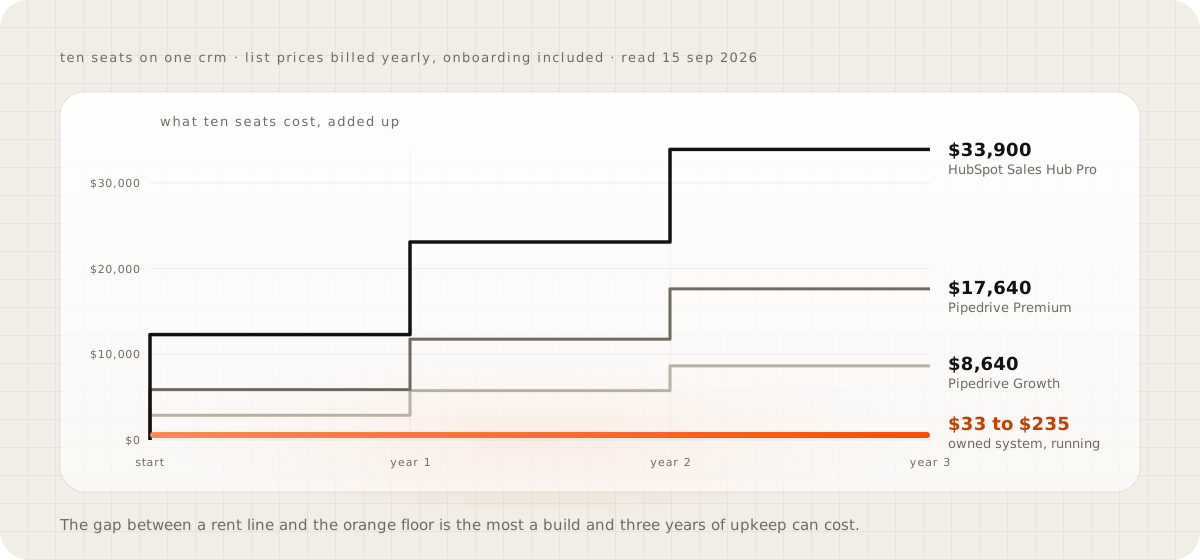
Ten people on HubSpot Sales Hub Professional pay $33,900 over three years at today's list price, the required onboarding included. The same ten people on Pipedrive's Growth plan pay $8,640. Those two numbers are the honest frame for custom software vs off the shelf, because a build only makes sense against the rent it would replace, and that rent varies by nearly four times.
None of the eight pages ranking for this search names a product's seat price, its contract terms or what an owned system costs to run. Those numbers are below, as they stood on 15 September 2026, and the case where renting wins comes first.
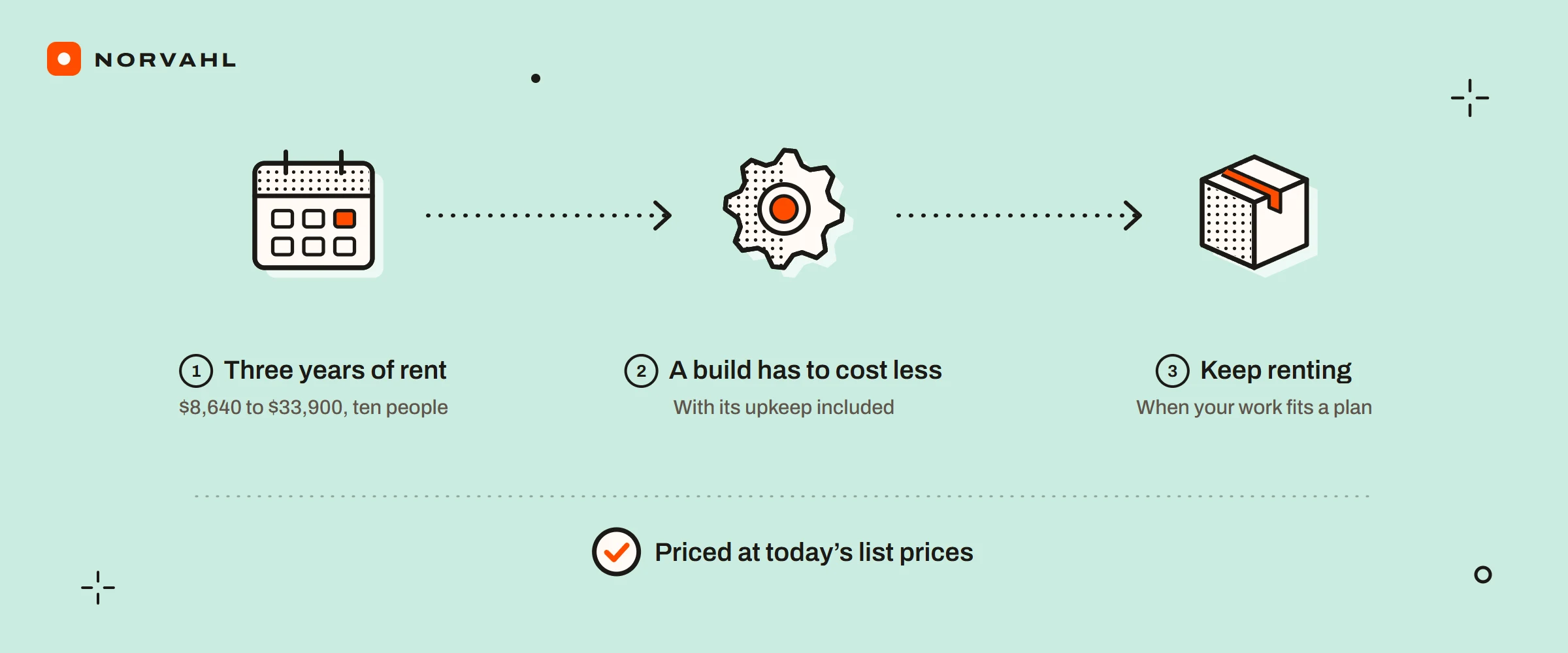
The short version Keep renting when your work fits a plan like Pipedrive Growth, where a build would have to cost under about $6,500 with its upkeep to beat three years of rent. Look at a build when the rent is closer to HubSpot Professional's $33,900, and only if the build comes in under about $21,000 to $26,000.
What renting one job costs a ten-person team#
Take a service business where ten people work the same pipeline, so all ten need a paid seat. On HubSpot's pricing page, Sales Hub Professional is $90 a seat a month billed yearly, or $100 on the monthly option, which still commits you for a year. Professional also carries a required $1,500 onboarding fee. Pipedrive's Growth plan, the first with automations, is $24 a seat billed yearly or $34 monthly, and Premium is $49 or $64.
Added up over 36 months on yearly billing, HubSpot Professional comes to $33,900, Pipedrive Premium to $17,640 and Pipedrive Growth to $8,640. Paying HubSpot monthly raises its total to $37,500. Keeping five paid seats and giving the other five people HubSpot's free view-only seats brings it down to $17,700.
How rented prices move, and what the contract allows#
The rent does not stay where it starts. Microsoft raised Microsoft 365 Business Basic from $6 to $7 a user, and Business Standard from $12.50 to $14, at renewals after 1 July 2026. Salesforce lifted its Enterprise and Unlimited list prices by an average of 6 percent from 1 August 2025. The SaaS inflation index from Vertice, built from the software contracts it processes, put the year-on-year rise at a record 16.4 percent in June 2026.
The contracts are written to allow it. HubSpot's customer terms let it raise fees at renewal up to its current list price with 30 days' notice and no cap, forbid a downgrade during the term, and make fees non-refundable. Pipedrive's terms of service let it change fees with a month's notice from the next renewal, and a seat cut only takes effect at the renewal date.
None of that makes renting a mistake. It means a three-year total should carry a guess. If HubSpot's list price rose 5 percent at each renewal, which is the figure it gave for its own 2024 seat change, the ten seats would cost $35,547 instead of $33,900.
What a build costs, from a survey of the people who sell them#
Published build prices are thinner than rent prices. GoodFirms' 2026 survey asked more than 100 software companies in September and October 2025 what they charge. Of those firms, 14.1 percent charge under $30,000 for a small project, and 65.7 percent charge $30,000 to $100,000 for a medium one. The same survey states that upkeep runs at 10 to 20 percent of the build a year.
Two limits come with those numbers. The people answering are sellers, not buyers, and the survey has no band for a small internal system. So instead of guessing a price for your build, work backwards from the rent. A build pays for itself inside three years when the build, three years of upkeep and about $235 of running costs come to less than the rent it replaces:
- Against HubSpot Professional's $33,900, the build has to cost under about $25,900 with upkeep at 10 percent a year, or $21,000 at 20 percent.
- Against Pipedrive Premium's $17,640, under about $13,400 or $10,900.
- Against Pipedrive Growth's $8,640, under about $6,500 or $5,300.
What moves a build's own price is in what custom software costs, and the cost estimator gives a range for your type of system.
What the desk behind this site costs to run#
The rent comparison needs a real owned system on the other side, so here is mine. The desk behind norvahl.com is a private back office with a pipeline, a visitor ledger and reports, plus an audit trail of every action taken in it. It runs on one Cloudflare Worker with one D1 database of 14 tables, on Cloudflare's free plan.
Free has hard limits, and they are specific. The D1 database's free plan allows 100,000 rows written a day and a 500 MB database. Each visit to this site writes 20 to 30 rows, which puts the write limit at about 4,000 visits a day. The site's go-live audit estimated about 220 MB of data a year at 100 visits a day, so the free database holds a little over two years at that pace.
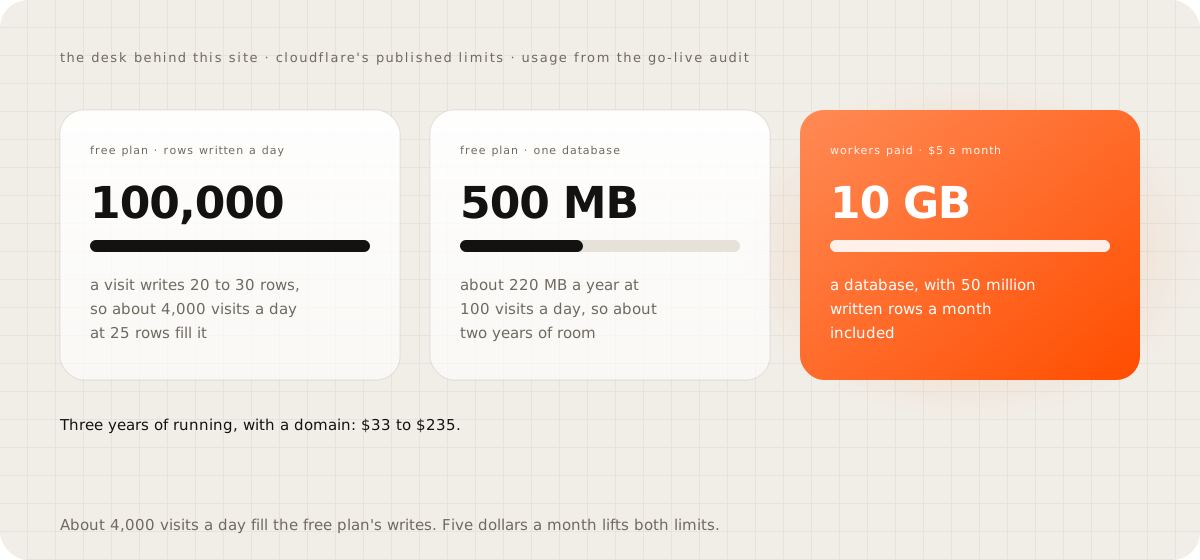
The paid plan is $5 a month. It raises the largest database to 10 GB and includes 50 million written rows a month. A .com domain renews at $11.08 to $18.48 a year, and email to your own verified address costs nothing on Cloudflare, so three years of running come to between about $33 and $235. That is the orange floor in the chart above. It leaves out the build and the upkeep, which is exactly why the break-even sums count them.
SaaS vs custom software, and when to keep renting#
Keep renting when the job is one everybody has. Email and accounting are the same job in every business, and so is a calendar, and the rented versions are good. Keep renting when your process changes every month, because a build freezes a process and a subscription does not. And keep renting when the rent is low: a ten-person team that fits Pipedrive Growth should not pay anyone to build a CRM.
Look at a build when three things are true at once. The rent is high and grows with every hire. The work is yours rather than everybody's, such as routing leads by your own rules or quoting from your own coverage maths. And someone can look after it. That last point is the real risk of owning, and it has its own section in when a business should build custom software.
Work out your own break-even#
Take the rent you pay for the one job: seats times the monthly price times 36, plus any setup fee. Take away about $235 for running an owned system. Divide what is left by 1.3 if you expect upkeep at 10 percent a year, or by 1.6 at 20 percent. That is the most a build can cost and still pay for itself inside three years.
Questions people ask
What is the difference between off-the-shelf and custom software?
Off-the-shelf software is built once and rented or sold to many businesses on the same terms, like a CRM subscription. Custom software is built around one business's own process and runs on accounts that business owns.
What are examples of off-the-shelf software?
The CRMs on this page, HubSpot and Pipedrive, are two, and so is Microsoft 365. Accounting packages, scheduling tools and help desks are sold the same way, one plan to many businesses, usually per seat.
What happens to my data if I cancel HubSpot or Pipedrive?
HubSpot's product terms give no access to Sales Hub data after the subscription ends, so export before the last day, including activity history such as calls and notes, which a contact export does not carry. Pipedrive's terms say it deletes the account and all its data within 180 days of termination.
Sources
- HubSpot Sales Hub pricing
- HubSpot customer terms of service
- HubSpot product specific terms
- Export records, HubSpot Knowledge Base
- Upcoming changes to HubSpot's pricing, 30 January 2024
- Pipedrive pricing
- Pipedrive terms of service
- Microsoft 365 pricing and packaging updates
- Salesforce pricing update, 17 June 2025
- SaaS inflation rate, Vertice
- Custom software development cost survey 2026, GoodFirms
- Workers pricing, Cloudflare developer documentation
- D1 pricing, Cloudflare developer documentation
- D1 limits, Cloudflare developer documentation
- Email Service pricing, Cloudflare developer documentation
- .com domain pricing, Porkbun
- .com domain pricing, Namecheap