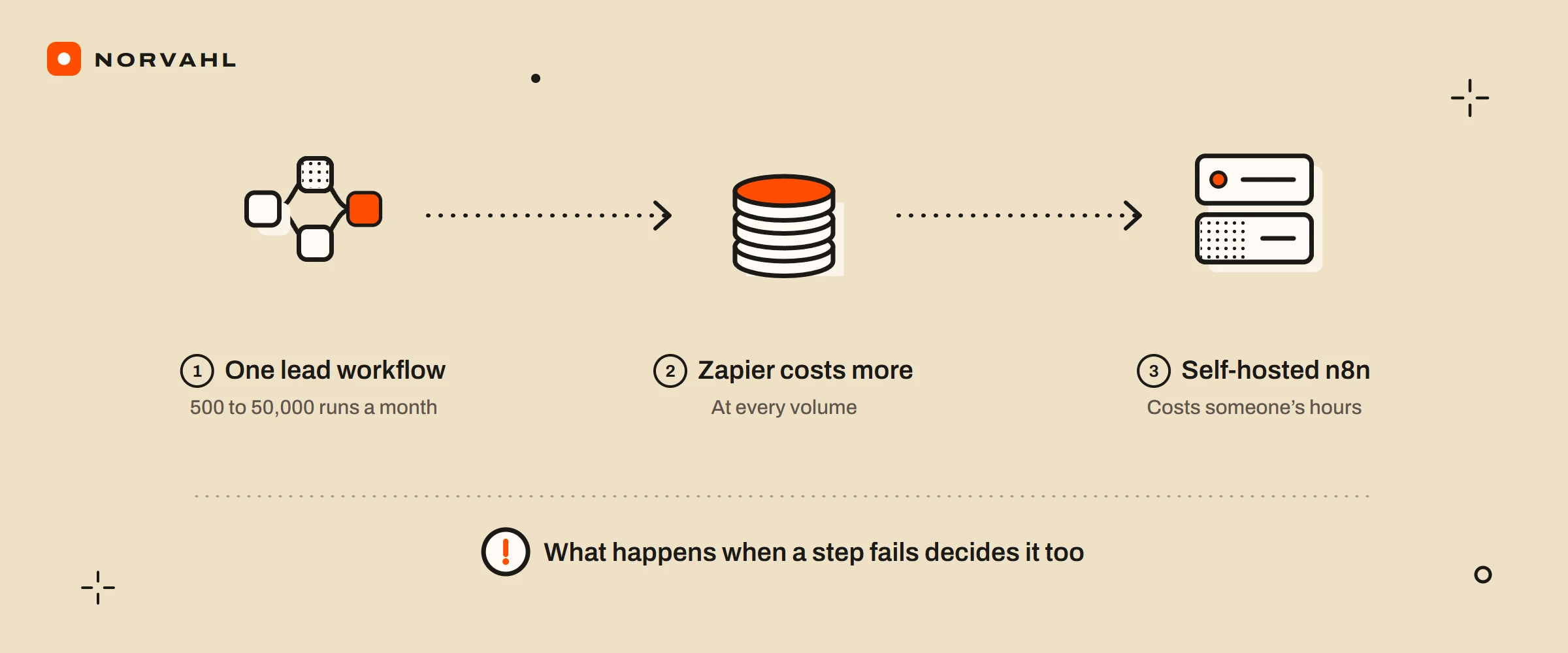
For one lead-routing workflow, Zapier costs more than n8n at every volume from 500 runs a month to 50,000, whether n8n runs in its own cloud or on a $12 server. So the n8n vs Zapier question is not which invoice is smaller. It is how much time the cheaper route takes to look after, and whether the saving pays for that time.
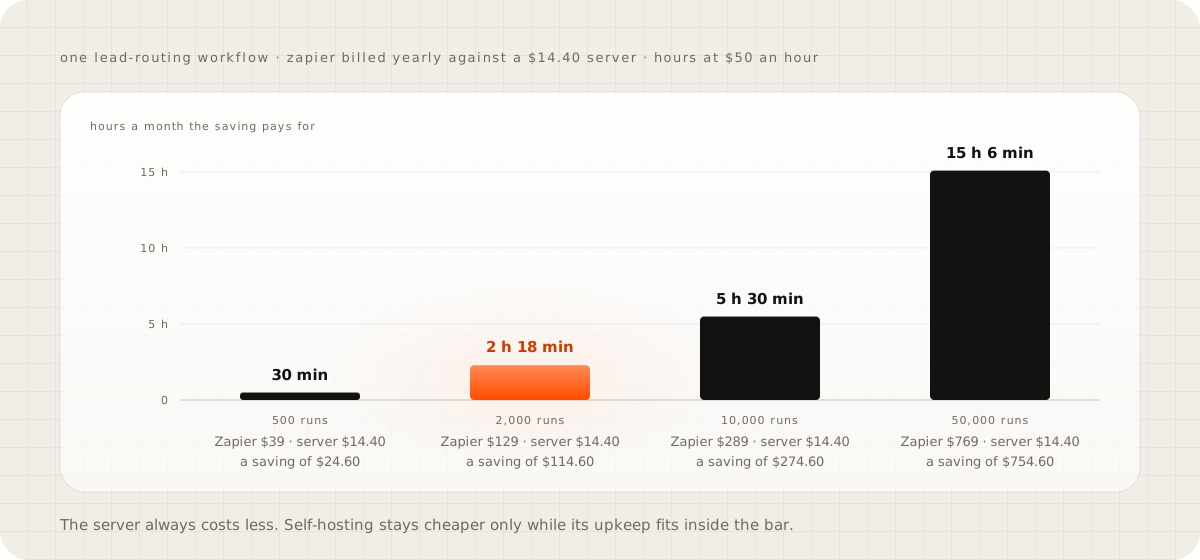
At 2,000 leads a month, self-hosting n8n saves $114.60 a month against Zapier's yearly price. At $50 an hour, that pays for 2 hours 18 minutes of upkeep. At 50,000 leads it pays for about 15 hours. The prices were read from each vendor's pricing page on 15 September 2026. The $50 is my assumption, so swap in what an hour of your time, or a freelancer's, actually costs.
The short version
- Choose Zapier if you want a failed step retried for hours without building anything, and its price at your volume is one you can live with.
- Choose n8n's cloud if you would rather pay per run than per step and stay under 10,000 runs a month, where its listed plans end.
- Self-host n8n if someone already looks after servers and the saving at your volume covers their hours.
The workflow and what each tool counts#
A form on your website sends each new lead to a webhook. A lookup in a Google Sheet finds which salesperson covers the lead's postcode, a deal is created in Pipedrive for that person, and an email tells them the lead is theirs. That is one trigger and three actions.
Zapier bills tasks, one for each action step that succeeds, and its pricing page does not count the trigger. This workflow uses 3 tasks a lead. Webhooks need the Professional plan or higher, so the free plan is out.
The n8n pricing page bills executions, and one execution is a whole run however many steps it has. Every lead is one execution on n8n's cloud. On your own server nothing is counted at all, and the bill is the server.
Neither count includes Pipedrive's own plan or the email service, which cost the same whichever tool runs the steps.
The bill at four volumes#
At 500 leads a month the workflow uses 1,500 Zapier tasks, and Zapier's 1,500-task tier costs $39 a month billed yearly or $58.50 billed monthly. On n8n's cloud, the Starter plan covers 2,500 executions for €20 a month billed yearly.
At 2,000 leads it is 6,000 tasks, which needs Zapier's 10,000-task tier at $129 a month billed yearly or $193.50 monthly. Starter still covers it.
At 10,000 leads it is 30,000 tasks, on the 50,000-task tier at $289 billed yearly or $433.50 monthly. On n8n's cloud this is exactly Pro's allowance of 10,000 executions, at €50 a month billed yearly, with no room for a busy month.
At 50,000 leads it is 150,000 tasks, on the 200,000-task tier at $769 billed yearly or $1,149 monthly. The plans n8n lists for its cloud end at 10,000 executions, so hosted n8n at this volume is a quote from sales.
Self-hosted n8n costs the same at all four volumes. A 2 GiB server at DigitalOcean is $12 a month, and weekly backups take it to $14.40. The Community Edition carries no licence fee, and its licence covers running your own business's workflows.
What the hours go on#
The bars are only useful next to an honest list of what self-hosting asks for. The n8n release notes say a new minor version comes out most weeks, with a stable version for production and a beta for the newest changes. Someone decides when to update, and checks that the workflows still run afterwards.
Backups are the second job. The weekly backups priced above restore the whole server, and someone has to know how to do that before the day it matters. The third job is watching for failed runs, which on a self-hosted server nobody does for you.
Zapier and n8n's cloud take the first two jobs off your list. The third stays with every option, and it is where the two tools differ most.
When the Pipedrive step fails#
Say Pipedrive is down for an hour when a lead arrives. On Zapier, Autoreplay retries the failed step up to five times. The gaps grow from 5 minutes to 30 minutes, then 1 hour, 3 hours and 6 hours, so the last attempt comes about 10 hours 35 minutes after the error. It is available from the Professional plan, switched on for the whole account or for one Zap. Steps that succeed in a replay use tasks again, and Zapier sends no error email until the last attempt fails.
On n8n, the node's Retry On Fail setting tries at most five times, at most five seconds apart, a cap n8n's maintainers closed as working as expected. An hour-long outage outlasts it by a wide margin, and the execution fails. What happens next depends on an error workflow, which runs when an execution fails if one was set in the workflow's settings, and can send someone a link to the failed run.
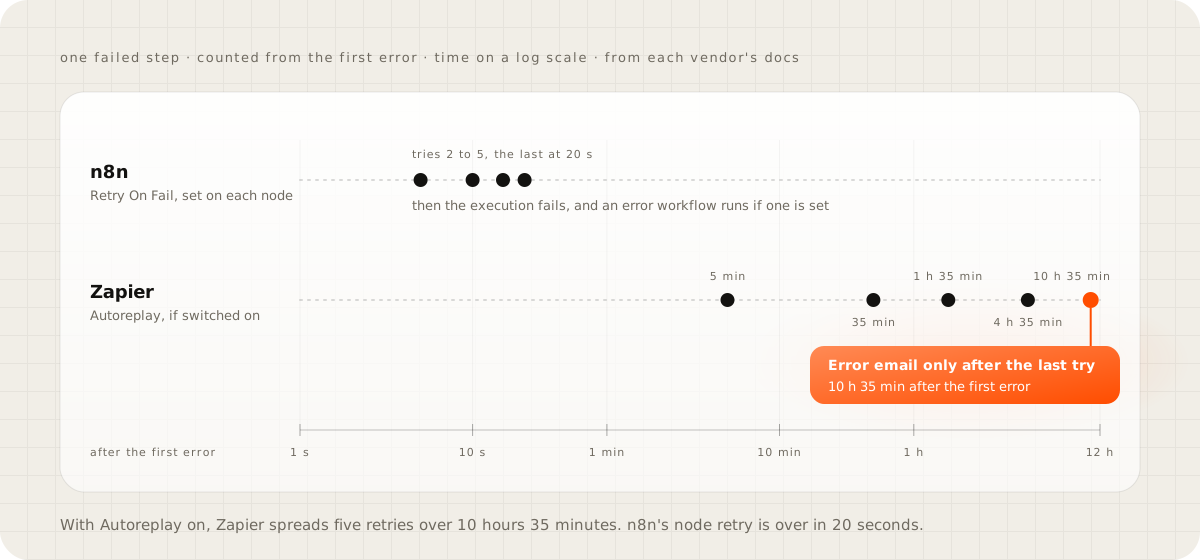
Neither tool is careless here. Zapier's retries ride out a long outage but tell you late, while n8n can tell you within seconds, but only if someone built the error workflow. In both, the lead exists only inside that run until a retry succeeds, and Zapier keeps up to 60 days of run history. The same failure followed through Make as well is on n8n vs Make.
Routing rules in a database of your own#
A third way out of per-task pricing is a small program on a Cloudflare Worker, with the routing rules kept in your own database instead of a spreadsheet lookup. Every lead is saved before anything calls Pipedrive, so an outage delays the deal rather than losing the lead. The routing hub on the homepage, built for a network of concrete-coating installers, gives a sense of the speed. It assigns a lead in a median of 2.4 seconds, and passes it to the next installer when nobody claims it within 15 minutes.
Hosting fits Cloudflare's Workers free plan, which allows 100,000 requests a day. The real cost is the build, and at 500 leads a month, against Zapier's $39 or n8n's €20, it does not pay back. It pays back once the routing rules are the business's own and the task bill has grown past the cost of the build.
Before you pick#
Work out your own bar first. Take the Zapier price at your volume, subtract $14.40 for a backed-up server, and divide by what an hour of upkeep costs you. If the upkeep would take longer than that each month, Zapier or n8n's cloud is the cheaper choice, whatever the invoice says. If you are still deciding which job to automate at all, start with what to automate first.
Questions people ask
Is n8n open source?
Not in the usual sense. Its code is public, but the Sustainable Use License limits use to your own internal business purposes, or to non-commercial or personal use, and n8n describes it as fair-code. Zapier's code is not public.
What happens when a Zapier plan runs out of tasks?
With pay-per-task switched on, Zaps keep running and extra tasks cost 1.25 times the base rate on yearly plans, or 2.5 times on monthly plans, up to a hard stop at three times the plan's tasks. With it switched off, Zaps stop at the limit until the next billing period.
Can this workflow run on Zapier's free plan?
No. The free plan allows 100 tasks a month and no Webhooks or multi-step Zaps, and this workflow starts from a webhook and has three actions. The cheapest plan that runs it is Professional at $19.99 a month billed yearly, whose 750 tasks cover 250 leads.
Sources
- Zapier pricing
- What is replay, Zapier Help Center
- View and manage your Zap history, Zapier Help Center
- n8n pricing
- Release notes, n8n Docs
- Handle errors gracefully, n8n Docs
- Retry On Fail limits, n8n issue 23658 on GitHub
- Sustainable Use License, n8n on GitHub
- Droplet pricing, DigitalOcean
- Workers pricing, Cloudflare developer documentation